


Imagine you are exploring a new country and walking into a store, where no one speaks English or your local language. The products look great, the prices seem fair, but you can not get answers to your basic questions. What do you do? You leave.
That is exactly what happens to thousands of potential customers on Shopify stores every single day.
The global eCommerce market is booming. Shopify merchants are selling to customers across continents, time zones and most importantly, languages. Yet, most stores still have an FAQ page written only in English. That is a missed opportunity of enormous scale.
A multilingual FAQ changes that. It speaks to your customers in their own language, answers their doubts before they arise and ultimately turns hesitant visitors into confident buyers.
In this blog, we will break down exactly what a multilingual FAQ is, why your Shopify store needs one and how it directly impacts your growth.
What Is a Multilingual FAQ?
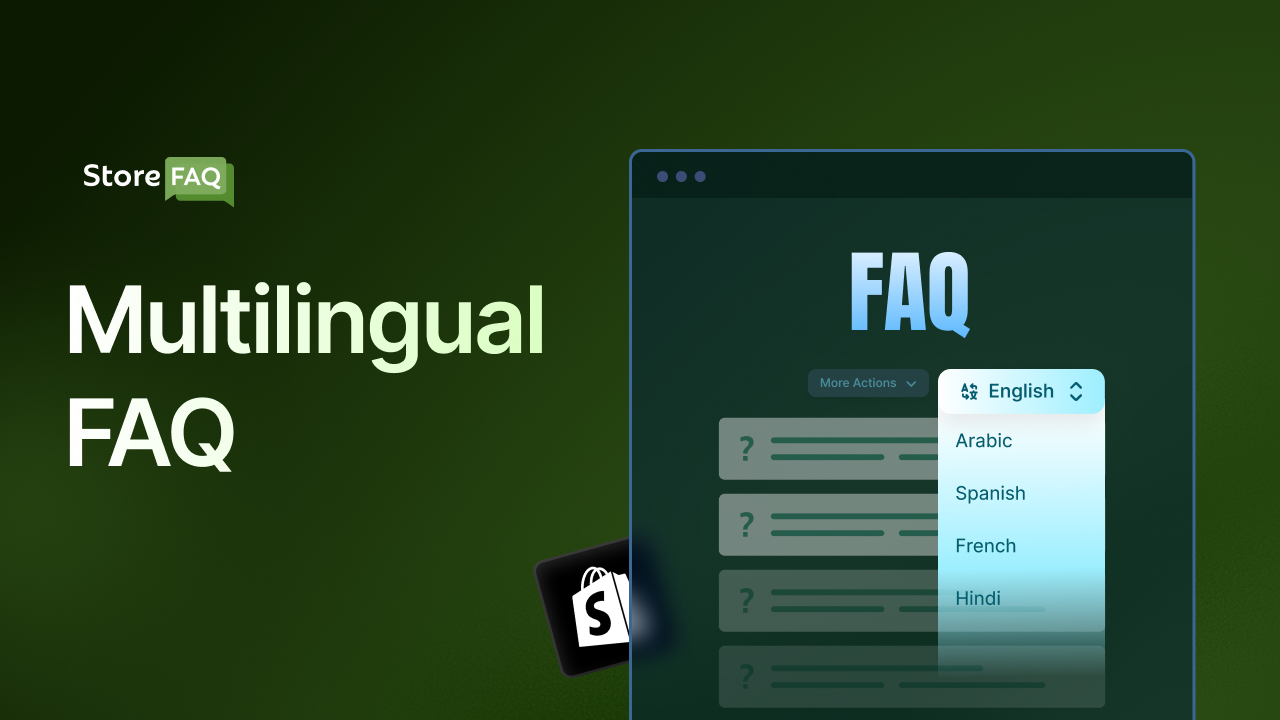
A multilingual FAQ (Frequently Asked Questions) is simply a FAQ section that is available in more than one language. Instead of having a single English version of your questions and answers, you offer the same information in multiple languages, whether that is Spanish, French, German, Arabic, Hindi, or any other language your customers speak.
On a Shopify store, this means a customer visiting from Mexico sees the FAQ in Spanish. A customer from Japan sees it in Japanese. The content is the same, but the language adapts to the reader.
It is not just about translation. A well-built multilingual FAQ is about making every customer feel like your store was built for them, regardless of where they are from. The language gap is costing you sales.
Here is something worth thinking about. When you set up a Shopify store, you are not just opening a local shop. You are opening a storefront that anyone in the world can visit. That is the beauty of eCommerce and also the challenge.
Why the FAQ Page Matters More Than You Think?
The FAQ page is often underestimated. Many store owners treat it as an afterthought, something to quickly fill in and forget about. But in reality, the FAQ page does a lot of heavy lifting.
Think about what a customer does before they buy something online. They want to know:
- How long does shipping take?
- What is the return policy?
- Is this product the right size for me?
- How do I contact support?
- Is my payment information secure?
These questions run through every shopper’s mind. If they can not find clear answers, they abandon the cart and move on. A strong FAQ page answers these questions before the customer even thinks to ask them. It removes friction from the buying journey.
Now multiply that by a customer who is not confident in English. Their doubts are even bigger. Their hesitation is even stronger. A multilingual FAQ steps in and gives them the clarity they need in a language they are comfortable with.
Let us walk through a real scenario.
A customer in Germany discovers your Shopify store through an Instagram ad. They click through, browse your products and find something they love. But before they buy, they have questions. How long will shipping take to Germany? Can they return the item if it does not fit? Is there a customer service number?
They navigate to your FAQ page. If it is only in English, they either struggle through it or give up. But if your FAQ is available in German, they read through it easily, get their answers and feel confident enough to complete the purchase.
That is the journey a multilingual FAQ enables. It is the difference between a lost sale and a happy customer.
Now imagine that happening at scale, across hundreds of German, French, Spanish and Japanese customers every month. The cumulative impact on your revenue is significant.
The Benefits of a Multilingual FAQ for Shopify Stores
According to CSA Research, 76% of online shoppers prefer to buy products in their native language. More strikingly, 40% of shoppers say they will never buy from websites that are not in their language.
These are not small numbers. They represent a massive portion of your potential customer base, walking away not because your product is bad, but because your store did not speak their language.
Your Shopify store might already be getting international traffic. Google Analytics can tell you that. But if your FAQ page is only in English, you are leaving those visitors without the support they need to complete a purchase.
A multilingual FAQ is one of the most direct ways to bridge that gap. Below are the benefits of a multilingual FAQ for Shopify.
1. It Builds Trust with International Customers
Trust is the currency of eCommerce. Customers buy from stores they trust. When a customer sees your FAQ in their own language, it sends a clear message: “We see you. We care about your experience.”
That kind of personalisation builds an emotional connection. It tells international shoppers that your store is not just tolerating them as customers, but it is actively welcoming them.
Trust leads to conversions. And conversions lead to revenue.
2. It Reduces Support Tickets And Inquiries
Every time a customer can not find an answer in your FAQ, they either leave or contact your support team. If they contact support, it takes time and money to answer questions that could have been handled automatically.
A multilingual FAQ handles this at scale. When customers can read and understand your FAQs clearly in their own language, they get their answers without needing to reach out. Your support team spends less time on repetitive questions and more time on complex issues that actually need human attention.
For growing Shopify stores, this efficiency is invaluable. It keeps your operations lean while delivering a better customer experience.
3. It Directly Improves Your Conversion Rate
Here is the business case in plain terms: more understanding equals more buying.
When customers are confused or unsure, they do not buy. When they feel informed and confident, they do. A multilingual FAQ removes the language barrier that confuses. It gives non-English-speaking shoppers the same quality of information that your English-speaking customers receive.
The result? Fewer abandoned carts. Higher checkout completion rates. Better overall conversion numbers.
It is not a complicated equation. Clarity drives conversions and a multilingual FAQ delivers clarity in every language.
4. It Supports Your SEO in Multiple Languages
This is a benefit that many Shopify merchants overlook. A multilingual FAQ does not just help your customers, it also helps search engines find your store.
When your FAQ content exists in multiple languages, it gets indexed by search engines in those languages. That means your store can appear in Google searches made in Spanish, French, German and beyond. You are essentially expanding your organic reach without running additional ad campaigns.
For example, if someone in Brazil searches for “como rastrear meu pedido” (how to track my order) and your FAQ page has that content in Portuguese, your store has a chance of showing up in those results.
Multilingual FAQ content is a long-term SEO investment that keeps paying off.
5. It Creates a Consistent Brand Experience Globally
Your brand voice matters. When English-speaking customers visit your store, they get a polished, professional experience. Your product descriptions are well-written. Your policies are clearly explained. Your FAQ is helpful and on-brand.
But what about customers in other languages? If they are relying on automatic browser translation tools, the experience is inconsistent at best and confusing at worst. Machine translations often miss tone, context and nuance.
A properly built multilingual FAQ ensures that every customer, no matter the language, gets the same quality experience. That consistency strengthens your brand globally.
What Makes a Good Multilingual FAQ?
So, you might be thinking, what makes a good multilingual FAQ? Not all multilingual FAQs are created equal. Here is what separates a good Shopify multilingual FAQ from a great one.
- Accuracy over speed. It is tempting to run your FAQ through a free translation tool and call it done. But poor translations can confuse customers or, worse, damage your brand reputation. Wherever possible, use quality translation tools or professional translators for languages critical to your business.
- Keep the language simple. This applies in every language, not just English. Your FAQ answers should be easy to read and understand. Avoid jargon. Use short sentences. Get to the point quickly.
- Organise by category. Group your questions logically: Shipping, Returns, Payments, Products, etc. This structure should be maintained across all language versions so customers can navigate easily, no matter what language they are reading in.
- Update all versions simultaneously. When you update your FAQ in English, make sure the updates are reflected in all other language versions too. Outdated information in any language can mislead customers and create support problems.
- Test the experience as a customer. Switch your browser or store to a different language and read through the FAQ yourself. Does it make sense? Is the formatting clean? Are the answers helpful? Seeing it from a customer’s perspective helps you catch issues early.
Shopify Apps That Can Help You Create Multilingual FAQ
Shopify has a growing ecosystem of apps that make multilingual content manageable. Here are some directions worth exploring:
Dedicated Shopify FAQ apps like StoreFAQ offer multilingual support, letting you create structured FAQ sections that can be presented in different languages.
Shopify Markets is Shopify’s built-in feature for international selling. It allows you to create localised experiences for different regions, including language settings and currency conversion.
Translation apps like Langify, Weglot, or Translate & Adapt (Shopify’s native tool) can help you translate your store content, including your FAQ, into multiple languages. Each has its own strengths, so it is worth comparing them based on your specific needs.
The right combination of tools depends on how many languages you need, your budget, and how technical you’re comfortable getting. But the good news is — Shopify makes it increasingly accessible even for non-technical store owners.
A Note on Cultural Sensitivity
Translating your FAQ is important. But there is another layer that is worth mentioning: cultural context.
Language is not just words. It is tone, formality and expectation. In some cultures, formal language in customer communication is expected. In others, a casual and friendly tone works better. Understanding these nuances can take your multilingual FAQ from functional to truly excellent.
This does not mean you need to become an expert in every culture. But if you are heavily targeting a specific country, it is worth getting local input. Even if it is just from a native-speaking friend or a freelancer, reviewing your translated content for cultural appropriateness is what you can consider as well. Small details like this can make a meaningful difference in how international customers perceive your brand.
Most Shopify stores competing in your niche are probably not offering a multilingual FAQ. That means if you build one, you are instantly offering a better experience than the majority of your competitors to international customers.
In a crowded eCommerce market, differentiation matters. Price is often not enough. Product quality alone is often not enough. But consistency in delivering an excellent customer experience, including support in the customer’s own language, is something that stands out.
A multilingual FAQ is not just a support feature. It is a competitive advantage.
Speak Your Customer’s Language
Growing a successful Shopify store in today’s market means thinking globally. It means recognising that your customers come from everywhere, speak different languages and deserve the same quality of experience regardless of where they are from.
A multilingual FAQ is one of the most practical and high-impact steps you can take toward that goal. It builds trust, reduces support burden, improves conversions and helps your store rank in international searches. Most importantly, it tells your global customers that your store was built with them in mind.
You do not need to do everything at once. Start with the languages most represented in your current traffic. Build from there. Your customers are already at the door. A multilingual FAQ helps you open it for all of them.
Was this blog helpful? If you want to have updates on more blogs, articles, and news like this, subscribe to our blogs.